 Gallery wall minus Flagler Era paintings
Our removal of microfilm reels and microfilm equipment has been much slower. Last spring we determined that we needed some of the space then occupied by the microfilm to create a quiet study area in the Research Room. At the same time there was also a need to expand the adjacent room which houses technology equipment, so plans were initiated to convert the remaining freed up floor space to that purpose. We were able to make both of these spaces available because students have substantially reduced their use of microfilm as a result of the more efficient access to journal page images provided today via subscriptions to the electronic databases-- particularly JSTOR, Proquest, Ebscohost, and Wilson Omnifile. We were able to reduce our microfilm holdings from 17 cabinets down to only 3 cabinets, and need only 2 reader printers (of the original 6) to access the remaining microfilm. As a result, we ended up with approximately 6,000 reels (75 storage boxes) of microfilm, 14 microfilm cabinets, and 4 reader printers to be removed.
 Surplus reader printers & cabinets
Finding “good homes” for the microfilm and its associated equipment has been interesting. Florida’s Bureau of Braille and Talking Books Library Services was the first to pick up 6 of our microfilm cabinets to store the master cassette recordings of their talking books. Our local St. Augustine Foundation, accepted one of our reader-printers, and now is finally able to print copies of their valuable historic microfilm at their own location. The remaining 3 reader-printers and one cabinet will soon be provided to the St. Augustine Historical Society Research Library, and the Florida State Library in Tallahassee will be the recipient of the final 7 cabinets.
 75 boxes of surplus reels of microfilm
  University of Kurdistan Hawler Library
Finally, as we continue to review sections of our books collection for both currency and relevancy, we identify books that we judge to no longer belong or be needed in our collection and we “weed” them out. These weeded books are disposed of in three different directions. Damaged books and those including information which is out of date are permanently disposed of. Books that still have a market value and have the potential to earn some funds that can be used to purchase new books for the Library are being set aside and will soon be shipped to a used book broker. All remaining books are moved to book carts that are periodically moved out to the lobby of the Library and made available as “give away" books for all members of the Flagler community.

Carts of "give away" books
So things really are disappearing from the Proctor Library. But at least for the items described above the removal is carefully planned and controlled.


 Room 133 had formerly been referred to by many simply as the “microfilm room” because as one looked into the room much of the floor space was taken up by 8 separate microfilm reader/printer machines and 16 very large cabinets containing microfilm reels holding our historical back file of journal issues. In addition, the perimeter of the room was filled with 16 computer workstations, so the room could easily become a crowded, and even noisy, place as well.
 So Library Room 133, the O’Keefe Research Room, is now designated as a “Quiet Room” with signage and posted rules targeted at providing a good space for individuals to engage in quiet work and study. The mixture of furnishings—a reduced number of computers and microfilm equipment, uncluttered study carrels and tables, and even a few individual chair arrangements—should make the area more conducive to this quiet work and study. Quiet will be monitored by the Library staff, and the staff will respond to any infractions.
 We have been pleased to be able to respond to the suggestions of the students, and we look forward to this newly configured space complementing the noisier, but very active, other learning spaces throughout the Proctor Library.


 National Library Week and Proctor Library
 While most students have already completed their actual research by this time and are mostly involved in the final writing of their papers and completion of their other projects, the Library's reference librarians will still receive some end of the semester reference questions. Some may even resemble those coming from the student in the following video/audio clip. But we hope they don't :-)
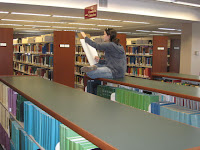 I learned from their professor, who was accompanying them, that they were observing and sketching various spaces in the library that allowed them to understand and illustrate "perspective." Aisles between ranges of bookshelves, long expanses of floor space, and many other areas on the library's second floor gave them the opportunity to illustrate a variety of perspectives.
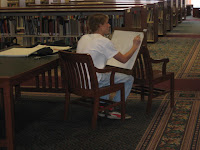 Once again it was a casual walk for me around the second floor, but just as the art students were observing different perspectives, so was I.