We will continue during this academic year to pursue this Vision, but to be honest it is not easy, particularly as one has to struggle to fully understand the impact of digitized collections on the physical library as well as on learning and teaching. It is with this background that I was delighted to discover a recent talk that addressed this exact topic. The talk was titled “Scholars Perspective: Impact of Digitized Collections on Learning and Teaching.” It was just presented in June 2008 to a Research Libraries Group (RLG) Symposium, in Philadelphia. The presenter was Dr. David Harrington Watt, who is both Director of General Education and Associate Professor of History at Temple University. I highly recommend a reading of a copy of his talk which is available at http://www.oclc.org/programs/events/2008-06-04a.pdf.
Dr. Watt’s combination of responsibilities provides a wonderful perspective with which to look at our topic of interest. As Director of General Education he has responsibility for promoting the elusive concept of “information literacy” at Temple because Temple requires that there must be an “information literacy” component in every general education class, and "information literacy" includes and is tied closely to students understanding and effectively using the digitized collection. At the same time, as Associate Professor of History Dr. Watt has empathy with his fellow faculty members who really can’t fully make sense of this category called “information literacy” and he sees that the faculty are resistant to making it part of their courses. Here at Flagler, we are still in the early stages of helping students (and faculty) fully understand and effectively use the digitized collections as well as traditional resources. This is our own “information literacy” goal, so we are obviously very interested in Dr. Watt’s observations and comments.
But in Dr. Watt’s words:
“So there is the bad news: we are living in a world in which there is good
reason to believe the students really do need to work on their informational
literacy and which faculty seem resistant to helping them do so.”
However, Dr. Watt also gives some better news because he suggests that one can negotiate through this dilemma by not hitting the faculty with the concept of “information literacy” but instead start learning from the faculty what hopes they have for their students. He has seen hopes expressed by faculty in such ways as:
“I want them to be able to distinguish between relative reliable primary sources
and ones that are less reliable.”“I want them to compare the data they get from reading physical primary sources
with that they get from reading from digital sources.”
In reality these are “information literacy” objectives but they really were not requested as such from the faculty. This is a lesson we can use here at Flagler.
Dr. Watt offered many other interesting thoughts in his talk concerning the impact of digitized collections on the physical library. For example, one challenge he mentions is the disappearance in many cases of professors running into other professors in the library, and of professors running into students. He had a good feeling about professors and students running into each other, and at the time they probably were involved in a common endeavor in research in one topic or another. Today he sees this same research going on, but the professor is in his office and the student may be in a computer lab. It ceases to be a common endeavor. He misses that interaction of students and professors within the physical library. Fortunately here at Flagler we still have several faculty working together with their students, helping them understand that all formats of information have value in research and many of these formats are only available in a physical library.

As the same time Dr. Watt also described the high value of the digital collections that are acquired today by libraries for use by students and other researchers. He presented the story of the undergraduate student from Temple who was able to write and publish an article in a scholarly journal using the digitized collection, "Early English Books Online," available to him through Temple’s library. He would probably never have been able to accomplish this in the past because of lack of timely access. While Flagler College may not be at the same level as Temple University with digitized collections--in particular collections of primary source documents--our own current digitized periodicals collections and subscriptions, including such ones as JSTOR, ATLA and PsycArticles, do provide access to thousands of digitized journal titles usable for research, as do our access to digitized collections of over 85,000 book titles.

So going back to my initial paragraph, I am pleased to say that our library is continuing to move forward toward achieving our vision, and I think Dr. Watt’s talk may give us some important thoughts to build upon as do our work. I again suggest a reading of a copy of his talk at
http://www.oclc.org/programs/events/2008-06-04a.pdf


 National Library Week and Proctor Library
 While most students have already completed their actual research by this time and are mostly involved in the final writing of their papers and completion of their other projects, the Library's reference librarians will still receive some end of the semester reference questions. Some may even resemble those coming from the student in the following video/audio clip. But we hope they don't :-)
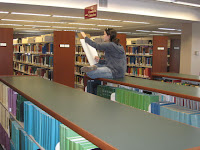 I learned from their professor, who was accompanying them, that they were observing and sketching various spaces in the library that allowed them to understand and illustrate "perspective." Aisles between ranges of bookshelves, long expanses of floor space, and many other areas on the library's second floor gave them the opportunity to illustrate a variety of perspectives.
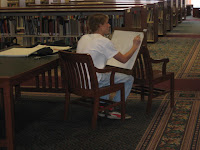 Once again it was a casual walk for me around the second floor, but just as the art students were observing different perspectives, so was I.
  From experience I knew in an instant who had been there – the Children’s Literature class from the Education Department. This class always seems to leave clear evidence. Earlier in the semester, we found cut-out, paper gingerbread men attached to all those areas of our collection containing children’s books or information about children’s books. The instructor for this class always amazes me, because these paper figures appear but I never see her attaching them. I’m sure she can teach our military about stealth actions. However, I did find more evidence of her class this morning, including my friend here:
 In other spaces our softer arm chairs have been moved into carrels or next to group study tables and have replaced the harder wood chairs. Sometimes even heavy tables have been moved to accommodate a bigger group. Blinds have been raised in some areas and lowered in others.


